School and Art and Design Marshall University Visual Arts Center 414
| Art Spiegelman | |
|---|---|
 Art Spiegelman in 2007 | |
| Built-in | Itzhak Avraham ben Zeev Spiegelman[1] (1948-02-15) February 15, 1948 Stockholm, Sweden |
| Nationality | American |
| Area(due south) | Cartoonist, Editor |
| Notable works |
|
| Spouse(s) | Françoise Mouly (m. 1977) |
| Children | 2, including Nadja Spiegelman |
Fine art Spiegelman (; born Itzhak Avraham ben Zeev Spiegelman on February 15, 1948) is an American cartoonist, editor, and comics abet all-time known for his graphic novel Maus. His work as co-editor on the comics magazines Arcade and Raw has been influential, and from 1992 he spent a decade as contributing artist for The New Yorker. He is married to designer and editor Françoise Mouly, and is the father of writer Nadja Spiegelman.
Spiegelman began his career with Topps (a bubblegum and trading card visitor) in the mid-1960s, which was his main fiscal support for two decades; there he co-created parodic series such as Wacky Packages in the 1960s and Garbage Pail Kids in the 1980s. He gained prominence in the secret comix scene in the 1970s with short, experimental, and often autobiographical work. A selection of these strips appeared in the collection Breakdowns in 1977, subsequently which Spiegelman turned focus to the book-length Maus, about his relationship with his male parent, a Holocaust survivor. The postmodern book depicts Germans equally cats, Jews as mice, and indigenous Poles as pigs, and took xiii years to create until its completion in 1991. It won a special Pulitzer Prize in 1992 and has gained a reputation as a pivotal work.
Spiegelman and Mouly edited eleven issues of Raw from 1980 to 1991. The oversized comics and graphics magazine helped introduce talents who became prominent in alternative comics, such as Charles Burns, Chris Ware, and Ben Katchor, and introduced several foreign cartoonists to the English-speaking comics world. Offset in the 1990s, the couple worked for The New Yorker, which Spiegelman left to work on In the Shadow of No Towers (2004), about his reaction to the September 11 attacks in New York in 2001.
Spiegelman advocates for greater comics literacy. Every bit an editor, a instructor at the Schoolhouse of Visual Arts in New York Urban center, and a lecturer, Spiegelman has promoted meliorate agreement of comics and has mentored younger cartoonists.
Family history [edit]

Spiegelman's parents were Shine Jews Władysław (1906–1982) and Andzia (1912–1968) Spiegelman. His father was born Zeev Spiegelman, with the Hebrew name Zeev ben Avraham. Władysław was his Smoothen name, and Władek (or Vladek in anglicized course) was a diminutive of this name. He was also known every bit Wilhelm under the German occupation, and Anglicized his name to William upon immigration to the United States. His mother was born Andzia Zylberberg, with the Hebrew proper noun Hannah. She changed her name to Anna upon immigrating to the U.s.. In Spiegelman'southward Maus, from which the couple are best known, Spiegelman used the spellings "Vladek" and "Anja", which he believed would be easier for Americans to pronounce.[3] The surname Spiegelman is German for "mirror man".[four]
In 1937, the Spiegelmans had one other son, Rysio (spelled "Richieu" in Maus), who died before Fine art was born,[i] at the age of five or six.[5] During the Holocaust, Spiegelman's parents sent Rysio to stay with an aunt with whom they believed he would be safe. In 1943, the aunt poisoned herself, along with Rysio and two other young family unit members in her care, so that the Nazis could non take them to the extermination camps. Later on the state of war, the Spiegelmans, unable to accept that Rysio was dead, searched orphanages all over Europe in the hope of finding him. Spiegelman talked of having a sort of sibling rivalry with his "ghost blood brother"; he felt unable to compete with an "platonic" brother who "never threw tantrums or got in any kind of trouble".[6] Of 85 Spiegelman relatives alive at the beginning of Globe State of war II, only 13 are known to have survived the Holocaust.[7]
Life and career [edit]
Early life [edit]

Spiegelman was born Itzhak Avraham ben Zeev[1] in Stockholm, Sweden, on Feb 15, 1948. He immigrated with his parents to the US in 1951.[8] Upon immigration his name was registered equally Arthur Isadore, but he later had his given proper name inverse to Fine art.[i] Initially the family unit settled in Norristown, Pennsylvania, and then relocated to Rego Park, Queens, New York City, in 1957.
He began cartooning in 1960[8] and imitated the way of his favorite comic books, such equally Mad.[9] In the early 1960s, he contributed to early fanzines such equally Smudge and Skip Williamson's Squire, and in 1962[10]—while at Russell Sage Inferior High Schoolhouse, where he was an honors student—he produced the Mad-inspired fanzine Blasé. He was earning money from his drawing by the time he reached high school and sold artwork to the original Long Isle Press and other outlets. His talent caught the optics of United Features Syndicate, who offered him the chance to produce a syndicated comic strip. Defended to the idea of art as expression, he turned downwardly this commercial opportunity.[9] He attended the High School of Art and Pattern in Manhattan beginning in 1963. He met Woody Gelman, the art managing director of Topps Chewing Gum Company, who encouraged Spiegelman to apply to Topps after graduating from high school.[viii] At historic period fifteen, Spiegelman received payment for his work from a Rego Park paper.[11]
After he graduated in 1965, Spiegelman'due south parents urged him to pursue the fiscal security of a career such as dentistry, merely he chose instead to enroll at Harpur Higher to study art and philosophy. While there, he got a freelance art job at Topps, which provided him with an income for the next 2 decades.[12]

Spiegelman attended Harpur College from 1965 until 1968, where he worked every bit staff cartoonist for the higher newspaper and edited a college humour magazine.[13] Later a summer internship when he was 18, Topps hired him for Gelman'due south Product Evolution Department[14] every bit a creative consultant making trading cards and related products in 1966, such equally the Wacky Packages series of parodic trading cards begun in 1967.[xv]
Spiegelman began selling self-published underground comix on street corners in 1966. He had cartoons published in hugger-mugger publications such equally the Due east Village Other and traveled to San Francisco for a few months in 1967, where the underground comix scene was just showtime to burgeon.[fifteen]
In late winter 1968, Spiegelman suffered a brief but intense nervous breakdown,[16] which cut curt his academy studies.[15] He has said that at the fourth dimension he was taking LSD with great frequency.[xvi] He spent a month in Binghamton State Mental Hospital, and shortly after he exited it, his mother died by suicide following the death of her only surviving brother.[17]
Surreptitious comics (1971–1977) [edit]
In 1971, subsequently several visits, Spiegelman moved to San Francisco[15] and became a part of the countercultural secret comix motility that had been developing there. Some of the comix he produced during this period include The Compleat Mr. Infinity (1970), a ten-folio booklet of explicit comic strips, and The Viper Vicar of Vice, Villainy and Vickedness (1972),[18] a transgressive piece of work in the vein of boyfriend secret cartoonist S. Dirt Wilson.[19] Spiegelman'southward work also appeared in underground magazines such as Gothic Blimp Works, Bijou Funnies, Young Lust,[15] Existent Pulp, and Bizarre Sex,[20] and were in a diverseness of styles and genres as Spiegelman sought his artistic voice.[19] He also did a number of cartoons for men's magazines such as Cavalier, The Dude, and Gent.[fifteen]
In 1972, Justin Green asked Spiegelman to do a iii-page strip for the first issue of Funny Aminals [sic].[21] He wanted to do i well-nigh racism, and at first considered a story[22] with African-Americans as mice and cats taking on the role of the Ku Klux Klan.[23] Instead, he turned to the Holocaust that his parents had survived. He titled the strip "Maus" and depicted the Jews equally mice persecuted past dice Katzen, which were Nazis as cats. The narrator related the story to a mouse named "Mickey".[21] With this story Spiegelman felt he had found his phonation.[11]
Seeing Greenish'due south revealingly autobiographical Binky Brown Meets the Holy Virgin Mary while in-progress in 1971 inspired Spiegelman to produce "Prisoner on the Hell Planet", an expressionistic work that dealt with his mother'due south suicide; it appeared in 1973[24] [25] in Brusk Order Comix #i,[26] which he edited.[15] Spiegelman'southward piece of work thereafter went through a phase of increasing formal experimentation;[27] the Apex Treasury of Underground Comics in 1974 quotes him: "As an art class the comic strip is barely in its infancy. So am I. Maybe we'll abound up together."[28] The often-reprinted[29] "Ace Pigsty, Midget Detective" of 1974 was a Cubist-style nonlinear parody of hardboiled crime fiction full of non sequiturs.[30] "A Twenty-four hours at the Circuits" of 1975 is a recursive unmarried-folio strip nearly alcoholism and depression in which the reader follows the graphic symbol through multiple never-ending pathways.[31] "Nervous Rex: The Malpractice Suite" of 1976 is made up of cut-out panels from the lather-opera comic strip King Morgan, M.D. refashioned in such a manner as to defy coherence.[27]
In 1973, Spiegelman edited a pornographic and psychedelic book of quotations and defended information technology to his female parent. Co-edited with Bob Schneider, it was called Whole Grains: A Book of Quotations.[32] In 1974–1975, he taught a studio cartooning class at the San Francisco Academy of Art.[18]
By the mid-1970s, the hugger-mugger comix movement was encountering a slowdown. To give cartoonists a safe booth, Spiegelman co-edited the anthology Arcade with Neb Griffith, in 1975 and 1976. Arcade was printed by The Impress Mint and lasted seven bug, five of which had covers by Robert Crumb. It stood out from similar publications past having an editorial plan, in which Spiegelman and Griffith attempt to prove how comics connect to the broader realms of creative and literary civilisation. Spiegelman's own work in Arcade tended to be short and concerned with formal experimentation.[33] Arcade too introduced art from ages past, too as contemporary literary pieces by writers such equally William S. Burroughs and Charles Bukowski.[34] In 1975, Spiegelman moved dorsum to New York Urban center,[35] which put near of the editorial work for Arcade on the shoulders of Griffith and his cartoonist married woman, Diane Noomin. This, combined with distribution problems and retailer indifference, led to the magazine's 1976 demise. Spiegelman swore he would never edit another magazine.[36]
Françoise Mouly, an architectural student on a hiatus from her studies at the Beaux-Arts in Paris, arrived in New York in 1974. While looking for comics from which to practice reading English, she came across Arcade. Avant-garde filmmaker friend Ken Jacobs introduced Mouly and Spiegelman, when Spiegelman was visiting, but they did non immediately develop a mutual interest. Spiegelman moved dorsum to New York later in the year. Occasionally the 2 ran beyond each other. After she read "Prisoner on the Hell Planet" Mouly felt the urge to contact him. An eight-hr phone call led to a deepening of their relationship. Spiegelman followed her to French republic when she had to return to fulfill obligations in her compages form.[37]
Spiegelman introduced Mouly to the world of comics and helped her find piece of work as a colorist for Marvel Comics.[38] After returning to the U.S. in 1977, Mouly ran into visa problems, which the couple solved by getting married.[39] The couple began to make yearly trips to Europe to explore the comics scene, and brought dorsum European comics to show to their circle of friends.[40] Mouly assisted in putting together the lavish, oversized collection of Spiegelman'due south experimental strips Breakdowns in 1977.[41]
Raw and Maus (1978–1991) [edit]

Breakdowns suffered poor distribution and sales, and xxx% of the print run was unusable due to printing errors, an feel that motivated Mouly to proceeds control over the printing process.[41] She took courses in start printing and bought a press printing for her loft,[42] on which she was to print parts of[43] a new magazine she insisted on launching with Spiegelman.[44] With Mouly every bit publisher, Spiegelman and Mouly co-edited Raw starting in July 1980.[45] The first effect was subtitled "The Graphix Magazine of Postponed Suicides".[44] While it included work from such established undercover cartoonists as Crumb and Griffith,[36] Raw focused on publishing artists who were nearly unknown, avant-garde cartoonists such equally Charles Burns, Lynda Barry, Chris Ware, Ben Katchor, and Gary Panter, and introduced English-speaking audiences to translations of foreign works by José Muñoz, Chéri Samba, Joost Swarte, Yoshiharu Tsuge,[27] Jacques Tardi, and others.[44]
With the intention of creating a book-length piece of work based on his begetter'southward recollections of the Holocaust[46] Spiegelman began to interview his father again in 1978[47] and made a research visit in 1979 to the Auschwitz concentration campsite, where his parents had been imprisoned by the Nazis.[48] The book, Maus, appeared 1 affiliate at a time as an insert in Raw beginning with the second issue in December 1980.[49] Spiegelman's begetter did not alive to see its completion; he died on 18 Baronial 1982.[35] Spiegelman learned in 1985 that Steven Spielberg was producing an animated film virtually Jewish mice who escape persecution in Eastern Europe by fleeing to the United States. Spiegelman was certain the film, An American Tail (1986), was inspired by Maus and became eager to accept his unfinished book come out before the film to avoid comparisons.[fifty] He struggled to find a publisher[7] until in 1986, after the publication in The New York Times of a rave review of the work-in-progress, Pantheon agreed to release a collection of the first six chapters. The volume was titled Maus: A Survivor'south Tale and subtitled My Father Bleeds History.[51] The book found a big audience, in function because it was sold in bookstores rather than in straight-market comic shops, which by the 1980s had become the ascendant outlet for comic books.[52]

Spiegelman began teaching at the School of Visual Arts in New York in 1978, and continued until 1987,[35] teaching alongside his heroes Harvey Kurtzman and Will Eisner.[53] "Commix: An Idiosyncratic Historical and Aesthetic Overview", a Spiegelman essay, was published in Print.[54] Some other Spiegelman essay, "High Art Lowdown", was published in Artforum in 1990, critiquing the Loftier/Low exhibition at the Museum of Modern Fine art.[54]
In the wake of the success of the Cabbage Patch Kids series of dolls, Spiegelman created the parodic trading card series Garbage Pail Kids for Topps in 1985. Similar to the Wacky Packages series, the gross-out factor of the cards was controversial with parent groups, and its popularity started a gross-out fad amid children.[55] Spiegelman called Topps his "Medici" for the autonomy and financial freedom working for the company had given him. The relationship was nevertheless strained over issues of credit and ownership of the original artwork. In 1989 Topps auctioned off pieces of art Spiegelman had created rather than returning them to him, and Spiegelman broke the relation.[56]
In 1991, Raw Vol. 2, No. iii was published; information technology was to be the last outcome.[54] The closing chapter of Maus appeared not in Raw [49] but in the second volume of the graphic novel, which appeared later that year with the subtitle And Here My Troubles Began.[54] Maus attracted an unprecedented amount of critical attending for a work of comics, including an exhibition at New York'south Museum of Modernistic Art[57] and a special Pulitzer Prize in 1992.[58]
The New Yorker (1992–2001) [edit]

Spiegelman and Mouly began working for The New Yorker in the early 1990s.
Hired by Tina Chocolate-brown[59] equally a contributing artist in 1992, Spiegelman worked for The New Yorker for x years. His outset cover appeared on the February 15, 1993, Valentine'due south Day result and showed a black Westward Indian woman and a Hasidic homo kissing. The cover acquired turmoil at The New Yorker offices. Spiegelman intended it to reference the Crown Heights anarchism of 1991 in which racial tensions led to the murder of a Jewish yeshiva pupil.[threescore] Twenty-1 New Yorker covers by Spiegelman were published,[61] and he also submitted some which were rejected for existence besides outrageous.[62]
Within The New Yorker 's pages, Spiegelman contributed strips such every bit a collaboration, "In the Dumps", with children's illustrator Maurice Sendak[63] [64] and an obituary to Charles G. Schulz, "Abstract Thought is a Warm Puppy".[65] Some other of Spiegelman'southward essays, "Forms Stretched to their Limits", in an issue was well-nigh Jack Cole, the creator of Plastic Man. It formed the basis for a book virtually Cole, Jack Cole and Plastic Man: Forms Stretched to their Limits (2001).[65]
The same twelvemonth, Voyager Visitor published The Complete Maus, a CD-ROM version of Maus with all-encompassing supplementary fabric, and Spiegelman illustrated a 1923 poem by Joseph Moncure March called The Wild Political party.[66] Spiegelman contributed the essay "Getting in Touch With My Inner Racist" in the September one, 1997, event of Mother Jones.[66]

Editorial cartoonist Ted Rall begrudged Spiegelman's influence in New York cartooning circles.
Spiegelman's influence and connections in New York cartooning circles drew the ire of political cartoonist Ted Rall in 1999.[67] In "The Male monarch of Comix", an commodity in The Hamlet Vocalization,[68] Rall defendant Spiegelman of the power to "brand or pause" a cartoonist'south career in New York, while denigrating Spiegelman as "a guy with 1 keen book in him".[67] Cartoonist Danny Hellman responded by sending a forged email nether Rall'due south name to 30 professionals; the prank escalated until Rall launched a defamation adjust against Hellman for $ane.5 million. Hellman published a "Legal Activity Comics" do good book to embrace his legal costs, to which Spiegelman contributed a back-embrace cartoon in which he relieves himself on a Rall-shaped urinal.[68]
In 1997, Spiegelman had his first children's volume published, Open Me...I'm a Dog, with a narrator who tries to convince its readers that information technology is a canis familiaris via popular-ups and an attached leash.[69] From 2000 to 2003, Spiegelman and Mouly edited three issues of the children'southward comics anthology Petty Lit, with contributions from Raw alumni and children'due south book authors and illustrators.[70]
Post-September xi (2001–present) [edit]

Spiegelman lived close to the World Trade Center site, which was known as "Basis Nothing" after the September 11 attacks that destroyed the World Trade Center.[71] Immediately following the attacks Spiegelman and Mouly rushed to their girl Nadja'southward schoolhouse, where Spiegelman'southward anxiety served only to increase his daughter's apprehensiveness over the situation.[61] Spiegelman and Mouly created a cover for the September 24 event of The New Yorker [72] [73] which at offset glance appears to be totally black, just upon shut examination information technology reveals the silhouettes of the Earth Trade Center towers in a slightly darker shade of blackness. Mouly positioned the silhouettes so that the North Belfry's antenna breaks into the "w" of The New Yorker 'due south logo. The towers were printed in black on a slightly darker blackness field employing standard iv-colour printing inks with an overprinted clear varnish. In some situations, the ghost images merely became visible when the magazine was tilted toward a lite source.[72] Spiegelman was critical of the Bush administration and the mass media over their handling of the September 11 attacks.[74]
Spiegelman did non renew his New Yorker contract subsequently 2003.[75] He later quipped that he regretted leaving when he did, as he could have left in protest when the magazine ran a pro-invasion of Iraq piece later in the year.[76] Spiegelman said his parting from The New Yorker was part of his full general disappointment with "the widespread conformism of the mass media in the Bush era".[77] He said he felt like he was in "internal exile"[74] following the September 11 attacks as the U.S. media had become "conservative and timid"[74] and did not welcome the provocative art that he felt the need to create.[74] Nevertheless, Spiegelman asserted he left not over political differences, as had been widely reported,[75] but because The New Yorker was not interested in doing serialized piece of work,[75] which he wanted to do with his side by side projection.[76]
Spiegelman responded to the September 11 attacks with In the Shadow of No Towers, deputed by German paper Die Zeit, where it appeared throughout 2003. The Jewish Daily Forward was the only American periodical to serialize the feature.[74] The nerveless work appeared in September 2004 as an oversized[a] board book of ii-page spreads which had to be turned on end to read.[78]
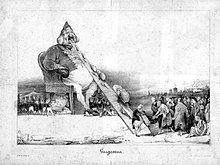
In the June 2006 edition of Harper's Magazine Spiegelman had an article published on the Jyllands-Posten Muhammad cartoons controversy; some interpretations of Islamic law prohibit the depiction of Muhammad. The Canadian chain of booksellers Indigo refused to sell the issue. Chosen "Drawing Blood: Outrageous Cartoons and the Art of Outrage", the commodity surveyed the sometimes dire effect political cartooning has for its creators, ranging from Honoré Daumier, who spent time in prison for his satirical work; to George Grosz, who faced exile. To Indigo the article seemed to promote the continuance of racial caricature. An internal memo brash Indigo staff to tell people: "the decision was made based on the fact that the content nigh to be published has been known to ignite demonstrations around the globe."[79] In response to the cartoons, Iranian president Mahmoud Ahmadinejad promoted an Iranian drawing contest seeking anti-Semitic cartoons. The organizers of the contest intended to highlight what they perceived as Western double standards surrounding anti-Semitism and Islamophobia. Spiegelman produced a cartoon of a line of prisoners beingness led to the gas chambers; i stops to look at the corpses around him and says, "Ha! Ha! Ha! What'southward really hilarious is that none of this is really happening!"[fourscore]
To promote literacy in young children, Mouly encouraged publishers to publish comics for children.[81] Disappointed past publishers' lack of response, from 2008 she self-published a line of like shooting fish in a barrel readers called Toon Books, past artists such as Spiegelman, Renée French, and Rutu Modan, and promotes the books to teachers and librarians for their educational value.[82] Spiegelman's Jack and the Box was one of the inaugural books in 2008.[83]
In 2008 Spiegelman reissued Breakdowns in an expanded edition including "Portrait of the Artist equally a Immature %@&*!"[84] an autobiographical strip that had been serialized in the Virginia Quarterly Review from 2005.[85] A book drawn from Spiegelman's sketchbooks, Exist A Nose, appeared in 2009. In 2011, MetaMaus followed—a book-length assay of Maus by Spiegelman and Hillary Chute with a DVD update of the earlier CD-ROM.[86]
Library of America deputed Spiegelman to edit the two-volume Lynd Ward: Six Novels in Woodcuts, which appeared in 2010, collecting all of Ward's wordless novels with an introduction and annotations by Spiegelman. The projection led to a touring show in 2014 about wordless novels chosen Wordless! with live music by saxophonist Phillip Johnston.[87] Art Spiegelman's Co-Mix: A Retrospective débuted at Angoulême in 2012 and by the cease of 2014 had traveled to Paris, Cologne, Vancouver, New York, and Toronto.[84] The book Co-Mix: A Retrospective of Comics, Graphics, and Scraps, which complemented the show, appeared in 2013.[88]
In 2015, after six writers refused to sit on a panel at the PEN American Heart in protestation of the planned "freedom of expression courage award" for the satirical French periodical Charlie Hebdo following the shooting at its headquarters before in the year, Spiegelman agreed to be one of the replacement hosts,[89] along with other names in comics such as writer Neil Gaiman. Spiegelman retracted a comprehend he had submitted to a Gaiman-edited "maxim the unsayable" upshot of New Statesman when the management declined to impress a strip of Spiegelman's. The strip, "Notes from a First Amendment Fundamentalist", depicts Muhammad, and Spiegelman believed the rejection was censorship, though the magazine asserted it never intended to run the cartoon.[xc]
In 2021, Literary Hub announced that Spiegelman was co-creating a work Street Cop with author Robert Coover.[91]
Personal life [edit]

Spiegelman married Françoise Mouly on July 12, 1977,[92] in a New York city hall ceremony.[39] They remarried after in the year later Mouly converted to Judaism to delight Spiegelman'due south male parent.[39] Mouly and Spiegelman have two children together: a daughter, Nadja Rachel, born in 1987,[92] and a son, Dashiell Alan, born in 1992.[92]
Fashion [edit]
"All comic-strip drawings must function equally diagrams, simplified picture-words that indicate more than they show."
—Art Spiegelman[93]
Spiegelman suffers from a lazy eye, and thus lacks depth perception. He says his art fashion is "really a issue of [his] deficiencies". His is a fashion of labored simplicity, with dense visual motifs which frequently get unnoticed upon first viewing.[94] He sees comics as "very condensed thought structures", more akin to poetry than prose, which need conscientious, time-consuming planning that their seeming simplicity belies.[95] Spiegelman's work prominently displays his business organization with form, and pushing the boundaries of what is and is not comics. Early in the underground comix era, Spiegelman proclaimed to Robert Crumb, "Time is an illusion that tin be shattered in comics! Showing the same scene from unlike angles freezes information technology in time by turning the folio into a diagram—an orthographic projection!"[96] His comics experiment with time, space, recursion, and representation. He uses the discussion "decode" to express the activity of reading comics[97] and sees comics as operation best when expressed every bit diagrams, icons, or symbols.[93]
Spiegelman has stated he does not see himself primarily equally a visual artist, one who instinctively sketches or doodles. He has said he approaches his piece of work as a writer as he lacks confidence in his graphic skills. He subjects his dialogue and visuals to constant revision—he reworked some dialogue balloons in Maus up to forty times.[98] A critic in The New Republic compared Spiegelman's dialogue writing to a immature Philip Roth in his ability "to make the Jewish oral communication of several generations sound fresh and disarming".[98]
Spiegelman makes apply of both old- and new-fashioned tools in his work. He prefers at times to work on paper on a drafting tabular array, while at others he draws direct onto his calculator using a digital pen and electronic cartoon tablet, or mixes methods, employing scanners and printers.[95]
Influences [edit]

Harvey Kurtzman has been Spiegelman's strongest influence equally a cartoonist, editor, and promoter of new talent.[99] Chief among his other early cartooning influences include Volition Eisner,[100] John Stanley's version of Little Lulu, Winsor McCay's Little Nemo, George Herriman's Krazy Kat,[99] and Bernard Krigstein's short strip "Principal Race".[101]
In the 1960s Spiegelman read in comics fanzines about graphic artists such every bit Frans Masereel, who had made wordless novels in woodcut. The discussions in those fanzines about making the Swell American Novel in comics later acted as inspiration for him.[46] Justin Green's comic book Binky Brown Meets the Holy Virgin Mary (1972) motivated Spiegelman to open up and include autobiographical elements in his comics.[102]
Spiegelman acknowledges Franz Kafka every bit an early influence,[103] whom he says he has read since the age of 12,[104] and lists Vladimir Nabokov, William Faulkner, Gertrude Stein among the writers whose work "stayed with" him.[105] He cites non-narrative advanced filmmakers from whom he has drawn heavily, including Ken Jacobs, Stan Brakhage, and Ernie Gehr, and other filmmakers such equally Charlie Chaplin and the makers of The Twilight Zone.[106]
Beliefs [edit]
Spiegelman is a prominent advocate for the comics medium and comics literacy. He believes the medium echoes the style the homo brain processes information. He has toured the U.Southward. with a lecture chosen "Comix 101", examining its history and cultural importance.[107] He sees comics' low status in the late 20th century as having come down from where information technology was in the 1930s and 1940s, when comics "tended to entreatment to an older audience of GIs and other adults".[108] Following the advent of the censorious Comics Code Authorization in the mid-1950s, Spiegelman sees comics' potential as having stagnated until the ascension of clandestine comix in the late 1960s.[108] He taught courses in the history and aesthetics of comics at schools such as the School of Visual Arts in New York.[35] As co-editor of Raw, he helped propel the careers of younger cartoonists whom he mentored, such as Chris Ware,[76] and published the piece of work of his School of Visual Arts students, such as Kaz, Drew Friedman, and Mark Newgarden. Some of the work published in Raw was originally turned in as class assignments.[53]
Spiegelman has described himself politically as "firmly on the left side of the secular-fundamentalist divide" and a "1st Amendment absolutist".[80] As a supporter of free speech, Spiegelman is opposed to detest oral communication laws. He wrote a critique in Harper'southward on the controversial Muhammad cartoons in the Jyllands-Posten in 2006; the consequence was banned from Indigo–Chapters stores in Canada. Spiegelman criticized American media for refusing to reprint the cartoons they reported on at the time of the Charlie Hebdo shooting in 2015.[109]
Spiegelman is a non-practicing Jew and considers himself "a-Zionist"—neither pro- nor anti-Zionist; he has called Israel "a sad, failed thought".[75] He told Peanuts creator Charles Schulz he was not religious, but identified with the "alienated diaspora civilisation of Kafka and Freud ... what Stalin pejoratively called rootless cosmopolitanism".[110]
Legacy [edit]
Maus looms large non only over Spiegelman'south body of piece of work, but over the comics medium itself. While Spiegelman was far from the first to do autobiography in comics, critics such as James Campbell considered Maus the work that popularized it.[eleven] The bestseller has been widely written about in the pop printing and academia—the quantity of its critical literature far outstrips that of any other work of comics.[111] It has been examined from a bully variety of academic viewpoints, though most often by those with footling agreement of Maus ' context in the history of comics. While Maus has been credited with lifting comics from popular culture into the world of high art in the public imagination, criticism has tended to ignore its deep roots in pop culture, roots that Spiegelman has intimate familiarity with and has devoted considerable time to promote.[112]
Spiegelman'southward belief that comics are best expressed in a diagrammatic or iconic manner has had a detail influence on formalists such as Chris Ware and his former student Scott McCloud.[93] In 2005, the September 11-themed New Yorker cover placed 6th on the elevation x of magazine covers of the previous twoscore years by the American Social club of Mag Editors.[72] Spiegelman has inspired numerous cartoonists to have upward the graphic novel as a means of expression, including Marjane Satrapi.[99]
A articulation ZDF–BBC documentary, Art Spiegelman's Maus, was televised in 1987.[113] Spiegelman, Mouly, and many of the Raw artists appeared in the documentary Comic Book Confidential in 1988.[54] Spiegelman's comics career was also covered in an Emmy-nominated PBS documentary, Serious Comics: Art Spiegelman, produced past Patricia Zur for WNYC-Boob tube in 1994. Spiegelman played himself in the 2007 episode "Husbands and Knives" of the animated telly series The Simpsons with fellow comics creators Daniel Clowes and Alan Moore.[114] A European documentary, Fine art Spiegelman, Traits de Mémoire, appeared in 2010 and later in English under the championship The Art of Spiegelman,[113] directed by Clara Kuperberg and Joelle Oosterlinck and mainly featuring interviews with Spiegelman and those around him.[115]
Awards [edit]
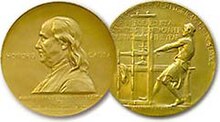
- 1982: Playboy Editorial Honour, All-time Comic Strip[116]
- 1982: Yellow Kid Award, Lucca, Italy, for Foreign Author[117] [116]
- 1983: Print, Regional Design Honour[116]
- 1984: Print, Regional Design Award[116]
- 1985: Print, Regional Design Accolade[116]
- 1986: Joel M. Cavior, Jewish Writing[118]
- 1987: Inkpot Award[116]
- 1988: Angoulême International Comics Festival, France, Prize for Best Comic Book, for Maus [54]
- 1988: Urhunden Prize, Sweden, Best Foreign Album, for Maus [119]
- 1990: Guggenheim Fellowship.[54]
- 1990: Max & Moritz Prize, Erlangen, Germany, Special Prize, for Maus [118]
- 1992: Pulitzer Prize Messages laurels, for Maus [120]
- 1992: Eisner Accolade, Best Graphic Album (reprint), for Maus [121]
- 1992: Harvey Accolade, All-time Graphic Anthology of Previously Published Work, for Maus [122]
- 1992: Los Angeles Times, Volume Prize for Fiction for Maus II [123]
- 1993: Angoulême International Comics Festival, Prize for Best Comic Book, for Maus II [54]
- 1993: Sproing Award, Norway, Best Foreign Album, for Maus [118]
- 1993: Urhunden Prize, Best Foreign Anthology, for Maus Ii [119]
- 1995: Binghamton University (formerly Harpur College), honorary Doctorate of Letters.[66]
- 1999: Eisner Award, inducted into the Hall of Fame[65]
- 2005: French government, Chevalier of the Ordre des Arts et des Lettres[65]
- 2005: Fourth dimension magazine, 1 of the "Superlative 100 Almost Influential People"[124]
- 2011: Angoulême International Comics Festival, Thou Prix[125]
- 2011: National Jewish Volume Award for MetaMaus: A Look Within a Mod Classic, Maus[126]
- 2015: American Academy of Arts and Letters membership[127]
- 2018: The Edward MacDowell Medal
Bibliography [edit]
[edit]
- Tijuana Bibles: Art and Wit in America's Forbidden Funnies, 1930s-1950s (Introductory Essay: Those Dirty Little Comics) (1977)
- Breakdowns: From Maus to At present, an Anthology of Strips (1977)
- Maus (1991)
- The Wild Party (1994)
- Open Me, I'm A Canis familiaris (1995)
- Jack Cole and Plastic Man: Forms Stretched to Their Limits (2001)
- In the Shadow of No Towers (2004)
- Breakdowns: Portrait of the Artist as a Young %@&*! (2008)
- Jack and the Box (2008)
- Be a Nose (2009)
- MetaMaus (2011)
- Co-Mix: A Retrospective of Comics, Graphics, and Scraps (2013)
- Street Cop (with Robert Coover) (2021)
Editor [edit]
- Short Order Comix (1972–74)
- Whole Grains: A Book of Quotations (with Bob Schneider, 1973)
- Arcade (with Bill Griffith, 1975–76)
- Raw (with Françoise Mouly, 1980–91)
- City of Glass (graphic novel adaptation by David Mazzucchelli of the Paul Auster novel, 1994)
- The Narrative Corpse (1995)
- Little Lit (with Françoise Mouly, 2000–2003)
- The TOON Treasury of Archetype Children'south Comics (with Françoise Mouly, 2009)
- Lynd Ward: Six Novels in Woodcuts (2010)
Notes [edit]
- ^ The book edition of In the Shadow of No Towers measures 10 in × fourteen.5 in (25 cm × 37 cm).[78]
References [edit]
- ^ a b c d Spiegelman 2011, p. 18.
- ^ Naughtie 2012.
- ^ Spiegelman 2011, p. 16.
- ^ Teicholz 2008.
- ^ Hatfield 2005, p. 146.
- ^ Hirsch 2011, p. 37.
- ^ a b Kois 2011.
- ^ a b c Witek 2007b, p. xvii.
- ^ a b Horowitz 1997, p. 401.
- ^ Gardner 2017, pp. 78–79.
- ^ a b c Campbell 2008, p. 56.
- ^ Horowitz 1997; D'Arcy 2011.
- ^ Witek 2007b, pp. xvii–xviii.
- ^ Jamieson 2010, p. 116.
- ^ a b c d e f 1000 Witek 2007b, pp. xviii.
- ^ a b Kaplan 2006, p. 102; Campbell 2008, p. 56.
- ^ Fathers 2007, p. 122; Gordon 2004; Horowitz 1997, p. 401.
- ^ a b Horowitz 1997, p. 402.
- ^ a b Kaplan 2006, p. 103.
- ^ Epel 2007, p. 144.
- ^ a b Witek 1989, p. 103.
- ^ Kaplan 2008, p. 140.
- ^ Conan 2011.
- ^ Brusk Club Comix #1 entry, Thousand Comics Database. Retrieved March 4, 2020.
- ^ Fox, M. Steven. Short Order Comix #i, Surreptitious ComixJoint. Retrieved March 4, 2020.
- ^ Witek 1989, p. 98.
- ^ a b c Chute 2012, p. 413.
- ^ Donahue, Don and Susan Goodrick, editors. The Apex Treasury of Underground Comics (Links Books/Quick Flim-flam, 1974).
- ^ Hatfield 2012, p. 138.
- ^ Hatfield 2012, p. 138; Chute 2012, p. 413.
- ^ Kuskin 2010, p. 68.
- ^ Rothberg 2000, p. 214; Witek 2007b, p. xviii.
- ^ Grishakova & Ryan 2010, pp. 67–68.
- ^ Buhle 2004, p. 252.
- ^ a b c d Witek 2007b, p. nineteen.
- ^ a b Kaplan 2006, p. 108.
- ^ Heer 2013, pp. 26–30.
- ^ Heller 2004, p. 137.
- ^ a b c Heer 2013, p. 41.
- ^ Heer 2013, pp. 47–48.
- ^ a b Heer 2013, pp. 45–47.
- ^ Heer 2013, p. 49.
- ^ Kaplan 2006, pp. 111–112.
- ^ a b c Kaplan 2006, p. 109.
- ^ Reid 2007, p. 225.
- ^ a b Kaplan 2008, p. 171.
- ^ Fathers 2007, p. 125.
- ^ Blau 2008.
- ^ a b Kaplan 2006, p. 113.
- ^ Kaplan 2006, p. 118; Kaplan 2008, p. 172.
- ^ Kaplan 2008, p. 171; Kaplan 2006, p. 118.
- ^ Kaplan 2006, p. 115.
- ^ a b Kaplan 2006, p. 111.
- ^ a b c d e f g h Witek 2007b, p. xx.
- ^ Bellomo 2010, p. 154.
- ^ Witek 2007a.
- ^ Shandler 2014, p. 338.
- ^ Liss 1998, p. 54; Fischer & Fischer 2002; Pulitzer Prizes staff.
- ^ Campbell 2008, p. 59.
- ^ Mendelsohn 2003, p. 180; Campbell 2008, p. 59; Witek 2007b, p. twenty.
- ^ a b Kaplan 2006, p. 119.
- ^ Play tricks 2012.
- ^ Spiegelman, Art; Sendak, Maurice (September 27, 1993). "In the Dumps". The New Yorker.
- ^ Weiss 2012; Witek 2007b, pp. xx–xxi.
- ^ a b c d Witek 2007b, p. xxii.
- ^ a b c Witek 2007b, p. xxi.
- ^ a b Campbell 2008, p. 58.
- ^ a b Arnold 2001.
- ^ Publishers Weekly staff 1995.
- ^ Witek 2007b, pp. xxii–xxiii.
- ^ Baskind & Omer-Sherman 2010, p. xxi.
- ^ a b c ASME staff 2005.
- ^ "ix/11 Mag Covers > The New Yorker", ASME/magazine.org. Retrieved 2016-08-13.
- ^ a b c d eastward Corriere della Sera staff 2003, p. 264.
- ^ a b c d Hays 2011.
- ^ a b c Campbell 2008, p. lx.
- ^ Corriere della Sera staff 2003, p. 263.
- ^ a b Chute 2012, p. 414.
- ^ Adams 2006.
- ^ a b Brean 2008.
- ^ Heer 2013, p. 115.
- ^ Heer 2013, p. 116.
- ^ Publishers Weekly staff 2008.
- ^ a b Solomon 2014, p. 1.
- ^ Witek 2007b, p. xxiii.
- ^ Heater 2011.
- ^ Cocked 2014.
- ^ Randle 2013.
- ^ Chow 2015.
- ^ Krayewski 2015; Heer 2015.
- ^ Temple, Emily (March ix, 2021). "Art Spiegelman and Robert Coover have collaborated (over Zoom!) on a new illustrated dystopian story". lithub.com. Literary Hub. Retrieved Baronial 17, 2021.
- ^ a b c Meyers 2011.
- ^ a b c Cates 2010, p. 96.
- ^ Campbell 2008, pp. 56–57.
- ^ a b Campbell 2008, p. 61.
- ^ Chute 2012, p. 412.
- ^ Chute 2012, pp. 412–413.
- ^ a b Campbell 2008, p. 57.
- ^ a b c Zuk 2013, p. 700.
- ^ Frahm 2004.
- ^ Kannenberg 2001, p. 28.
- ^ Chute 2010, p. 18.
- ^ Mulman 2010, p. 86.
- ^ Kannenberg 2007, p. 262.
- ^ Horowitz 1997, p. 404.
- ^ Zuk 2013, pp. 699–700.
- ^ Kaplan 2006, p. 123.
- ^ a b Campbell 2008, pp. 58–59.
- ^ Brean 2015.
- ^ Mendelsohn 2003, p. 180.
- ^ Loman 2010, p. 217.
- ^ Loman 2010, p. 212.
- ^ a b Shandler 2014, p. 318.
- ^ Keller 2007.
- ^ Kensky 2012.
- ^ a b c d e f Brennan & Clarage 1999, p. 575.
- ^ Traini 1982.
- ^ a b c Zuk 2013, p. 699.
- ^ a b Hammarlund 2007.
- ^ Pulitzer Prizes staff.
- ^ Eisner Awards staff 2012.
- ^ Harvey Awards staff 1992.
- ^ Colbert 1992.
- ^ Time staff 2005; Witek 2007b, p. xxiii.
- ^ Cavna 2011.
- ^ "National Jewish Book Award | Book awards | LibraryThing". www.librarything.com . Retrieved 2020-01-18 .
- ^ Artforum staff 2015.
Works cited [edit]
- Adams, James (2006-05-27). "Indigo pulls controversial Harper'due south off the shelves". The Globe and Mail. Archived from the original on 2009-02-06.
- Arnold, Andrew D. (2001-09-07). "Lemons into Lemonade". Time . Retrieved 2015-01-xix .
- Artforum staff (2015-02-25). "Art Spiegelman Named Member of American Academy of Arts and Letters". Artforum . Retrieved 2015-05-04 .
- Artsy, Avishay (2014-10-07). "Cartoonist Art Spiegelman reveals his influences in 'Wordless!'". The Jewish Periodical of Greater Los Angeles. Archived from the original on 2014-x-23. Retrieved 2015-05-04 .
- ASME staff (2005-10-17). "ASME's Acme forty Magazine Covers of the Last forty Years". American Society of Magazine Editors. Archived from the original on 2011-02-sixteen. Retrieved 2012-06-11 .
- Baskind, Samantha; Omer-Sherman, Ranen (2010). The Jewish Graphic Novel: Critical Approaches. Rutgers University Press. ISBN978-0-8135-4775-six.
- Bellomo, Marking (2010). Totally Tubular '80s Toys. Krause Publications. ISBN978-1-4402-1647-3.
- Blau, Rosie (2008-eleven-29). "Breakfast with the FT: Art Spiegelman". Financial Times . Retrieved 2012-04-18 .
- Brean, Joseph (2008-04-01). "Art Spiegelman: Politically correct 'fever' grips Canada". National Post . Retrieved 2015-05-04 .
- Brean, Joseph (2015-01-thirty). "Mark Steyn on boyfriend free-speech advocate Art Spiegelman and what it means to be truly provocative". National Post . Retrieved 2015-05-04 .
- Brennan, Elizabeth A.; Clarage, Elizabeth C. (1999). "Art Spiegelman". Who's Who of Pulitzer Prize Winners. Greenwood Publishing Group. pp. 574–575. ISBN978-one-57356-111-2.
- Buhle, Paul (2004). From the Lower Eastward Side to Hollywood: Jews in American Pop Civilization . Verso. ISBN978-1-85984-598-1.
- Campbell, James (2008). Syncopations: Beats, New Yorkers, and Writers in the Night . University of California Press. ISBN978-0-520-25237-0.
- Cates, Isaac (2010). "Comics and the Grammar of Diagrams". In Ball, David M.; Kuhlman, Martha B. (eds.). The Comics of Chris Ware: Drawing Is a Fashion of Thinking. University Printing of Mississippi. pp. 90–105. ISBN978-ane-60473-442-3.
- Cavna, Michael (Feb 1, 2011). "'Maus' creator reacts to winning comics' Chiliad Prix prize". The Washington Post . Retrieved Jan nineteen, 2015.
- Chow, Andrew R. (2015-05-03). "After Protest Over Award, Neil Gaiman and Art Spiegelman Agree to Be Table Hosts at PEN Gala". The New York Times . Retrieved 2015-03-04 .
- Chute, Hillary L. (2010). Graphic Women: Life Narrative and Gimmicky Comics. Columbia Academy Printing. ISBN978-0-231-15062-0.
- Chute, Hillary L. (2012). "Graphic Narrative". In Bray, Joe; Gibbons, Alison; McHale, Brian (eds.). The Routledge Companion to Experimental Literature. Routledge. pp. 407–419. ISBN978-0-415-57000-8.
- Colbert, James (1992-11-08). "Times Book Prizes 1992: Fiction: On Maus Ii". Los Angeles Times . Retrieved 2012-01-31 .
- Conan, Neal (2011-10-05). "'MetaMaus': The Story Behind Spiegelman's Classic". NPR . Retrieved 2012-05-08 .
- Corriere della Sera staff (2007) [2003]. "Art Spiegelman, Cartoonist for the New Yorker, Resigns in Protest at Censorship". In Witek, Joseph (ed.). Fine art Spiegelman: Conversations. Academy Press of Mississippi. pp. 263–266. ISBN978-1-934110-12-6.
- D'Arcy, David (2011-07-xiii). "Art Goes Dorsum to School". The Art Newspaper . Retrieved 2012-06-11 .
- Eisner Awards staff (2012). "Complete List of Eisner Award Winners". San Diego Comic-Con International. Archived from the original on 2011-04-27. Retrieved 2012-01-31 .
- Epel, Naomi (2007). "Fine art Spiegelman". In Witek, Joseph (ed.). Art Spiegelman: Conversations. University Press of Mississippi. pp. 143–151. ISBN978-1-934110-12-6.
- Fathers, Michael (2007). "Art Mimics Life in the Death Camps". In Witek, Joseph (ed.). Art Spiegelman: Conversations. University Press of Mississippi. pp. 122–125. ISBN978-1-934110-12-half-dozen.
- Fischer, Heinz Dietrich; Fischer, Erika J. (2002). "Spiegelman, Art". Complete Biographical Encyclopedia of Pulitzer Prize Winners, 1917–2000: Journalists, Writers and Composers on Their Ways to the Coveted Awards. Walter de Gruyter. p. 230. ISBN978-3-598-30186-v.
- Fox, Killian (2012-04-29). "The Covers the New Yorker Rejected". The Observer . Retrieved 2012-12-05 .
- Frahm, Ole (May 2004). "Considering MAUS. Approaches to Art Spiegelman's "Survivor's Tale" of the Holocaust by Deborah R. Geis (ed.)". Image & Narrative (8). ISSN 1780-678X. Retrieved 2012-01-30 .
- Gardner, Jared (Leap 2017). "Before the Hole-and-corner: Jay Lynch, Art Spiegelman, Skip Williamson and the Fanzine Culture of the Early 1960s". Inks: The Journal of the Comics Studies Society. The Ohio Land Academy Press. i (one): 75–99. doi:10.1353/ink.2017.0005. S2CID 194727887 – via Projection MUSE.
- Gordon, Andrew (2004). "Jewish Fathers and Sons in Spiegelman's Maus and Roth's Patrimony". ImageTexT. i (1). Archived from the original on 2005-12-31.
- Grishakova, Marina; Ryan, Marie-Laure (2010). Intermediality and Storytelling. Walter de Gruyter. ISBN978-3-11-023774-0.
- Hammarlund, Ola (2007-08-08). "Urhunden: Satir och iransk kvinnoskildring får seriepris" (in Swedish). Urhunden. Archived from the original on 2019-04-thirteen. Retrieved 2012-04-27 .
- Harvey Awards staff (1992). "1992 Harvey Award Winners". Harvey Awards. Archived from the original on 2016-03-15. Retrieved 2012-01-31 .
- Hatfield, Charles (2012). "An Art of Tensions". In Heer, Jeet; Worcester, Kent (eds.). A Comics Studies Reader. Academy Press of Mississippi. pp. 132–148. ISBN978-1-60473-109-five.
- Hatfield, Charles (2005). Alternative Comics: An Emerging Literature. University Printing of Mississippi. ISBN978-1-57806-719-0.
- Hays, Matthew (2011-10-08). "Of Maus and Man: Art Spiegelman Revisits his Holocaust Classic". The Globe and Postal service. Archived from the original on 2015-01-xix. Retrieved 2012-12-03 .
- Heater, Brian (October 11, 2011). "Art Spiegelman On The Future of the Book". Publishers Weekly . Retrieved January 19, 2015.
- Heer, Jeet (2013). In Honey with Art: Françoise Mouly'southward Adventures in Comics with Art Spiegelman. Coach House Books. ISBN978-1-77056-351-3.
- Heer, Jeet (2015-06-09). "The Controversy Over Muhammad Cartoons Is Not About the Prophet Muhammad". Archived from the original on 2015-06-x. Retrieved 2015-08-16 .
- Heller, Steven (2004). Design Literacy: Understanding Graphic Pattern. Skyhorse Publishing Inc. ISBN978-one-58115-356-9.
- Hirsch, Marianne (2011). "Mourning and Postmemory". In Chaney, Michael A. (ed.). Graphic Subjects: Critical Essays on Autobiography and Graphic Novels . University of Wisconsin Printing. pp. 17–44. ISBN978-0-299-25104-8.
- Horowitz, Sara R. (1997). "Art Spiegelman". In Shatzky, Joel; Taub, Michael (eds.). Contemporary Jewish-American Novelists: A Bio-Critical Sourcebook. Greenwood Publishing Group. pp. 400–408. ISBN978-0-313-29462-4.
- Jamieson, Dave (2010). Mint Condition: How Baseball Cards Became an American Obsession. Atlantic Monthly Press. ISBN978-0-8021-1939-i.
- Kannenberg, Gene, Jr. (2001). "'I Looked Simply Like Rudolph Valentino': Identity and Representation in Maus". In Baetens, January (ed.). The Graphic Novel. Leuven University Press. pp. 79–89. ISBN978-90-5867-109-7.
- Kannenberg, Gene, Jr. (2007). "A Conversation with Art Spiegelman". In Witek, Joseph (ed.). Art Spiegelman: Conversations. University Press of Mississippi. pp. 238–262. ISBN978-one-934110-12-6.
- Kaplan, Arie (2006). "Art Spiegelman". Masters of the Comic Volume Universe Revealed!. Chicago Review Printing. pp. 99–124. ISBN978-one-55652-633-6.
- Kaplan, Arie (2008). From Cracow to Krypton: Jews and Comic Books. Jewish Publication Society. ISBN978-0-8276-0843-vi.
- Keller, Richard (2007-11-18). "The Simpsons: Husbands and Knives". The Huffington Post . Retrieved 2014-ten-14 .
- Kensky, Eitan (2012-11-08). "Art Spiegelman Struggles With Success". The Forrard. Archived from the original on 2015-08-17. Retrieved 2015-08-17 .
- Kois, Dan (2011-12-02). "The Making of 'Maus'". The New York Times. Archived from the original on 2011-12-05. Retrieved 2012-01-27 .
- Krayewski, Ed (2015-06-03). "Art Spiegelman Pulls New Statesman Cover Considering It Wouldn't Impress a Cartoon Featuring Mohammed: 'Decease past a thousand buts'". Reason. Archived from the original on 2015-06-06. Retrieved 2015-08-16 .
- Kuskin, William (2010). "Vulgar Metaphysicians: William Southward. Burroughs, Alan Moore, Art Spiegelman, and the Medium of the Book". In Grishakova, Marina; Ryan, Marie-Laure (eds.). Intermediality and Storytelling. Walter de Gruyter. pp. 49–77. ISBN978-3-11-023773-3.
- Liss, Andrea (1998). Trespassing Through Shadows: Memory, Photography, and the Holocaust. University of Minnesota Press. ISBN978-0-8166-3060-viii.
- Loman, Andrew (2010). ""That Mouse's Shadow": The Canonization of Spiegelman's Maus". In Williams, Paul; Lyons, James (eds.). The Rise of the American Comics Artist: Creators and Contexts. University Press of Mississippi. pp. 210–235. ISBN978-one-60473-792-9 . Retrieved 2012-06-xi .
- Mendelsohn, Ezra (2003). "Jewish Universalism: Some Visual Texts and Subtexts". In Kugelmass, Jack (ed.). Key Texts in American Jewish Civilization. Rutgers Academy Printing. pp. 163–184. ISBN978-0-8135-3221-ix.
- Meyers, Julia Thou. (2011). "Corking Lives from History: Jewish Americans : Fine art Spiegelman". Salem Printing. Archived from the original on 2011-08-20. Retrieved 2012-04-18 .
- Mulman, Lisa Naomi (2010). "A Tale of Ii Mice: Graphic Representations of the Jew in Holocaust Narrative". In Baskind, Samantha; Omer-Sherman, Ranen (eds.). The Jewish Graphic Novel: Critical Approaches. Rutgers University Press. pp. 85–93. ISBN978-0-8135-4775-half dozen . Retrieved 2012-06-11 .
- Naughtie, James (2012-02-05). "Art Spiegelman". Bookclub. BBC Radio iv. Retrieved 2014-01-18 .
- Publishers Weekly staff (1995). "Children's Book Review: Open up Me...I'thou a Dog! by Art Spiegelman". Publishers Weekly . Retrieved 14 October 2014.
- Publishers Weekly staff (2008). "Children'southward Book Review: Jack and the Box by Fine art Spiegelman". Publishers Weekly . Retrieved fourteen October 2014.
- Pulitzer Prizes staff. "Special Awards and Citations". The Pulitzer Prizes . Retrieved 2013-11-02 .
{{cite web}}: CS1 maint: ref duplicates default (link) - Randle, Chris (2013-09-27). "Book Review: Co-Mix, past Fine art Spiegelman". National Mail . Retrieved 2015-05-04 .
- Reid, Calvin (2007). "Fine art Spiegelman and Françoise Mouly: The Literature of Comics". In Witek, Joseph (ed.). Art Spiegelman: Conversations. University Press of Mississippi. pp. 223–229. ISBN978-1-934110-12-6.
- Rothberg, Michael (2000). Traumatic Realism: The Demands of Holocaust Representation. University of Minnesota Press. ISBN978-0-8166-3459-0.
- Shandler, Jeffrey (2014). "Art Spiegelman: The Complete Maus". In Rebhun, Uzi (ed.). The Social Scientific Written report of Jewry: Sources, Approaches, Debates. Oxford University Press. pp. 337–341. ISBN978-0-xix-936349-0.
- Smith, Graham (2007) [1987]. "From Mickey to Maus: Recalling the Genocide Through Drawing". In Witek, Joseph (ed.). Art Spiegelman: Conversations. University Press of Mississippi. pp. 84–94. ISBN978-i-934110-12-six. (Originally in Oral History Journal Vol. 15, Spring 1987)
- Solomon, Alisa (2014-08-27). "The Haus of Maus: Art Spiegelman's twitchy irreverence". The Nation. Archived from the original on 2015-02-20. Retrieved 2015-05-04 .
- Spiegelman, Fine art (2011). Chute, Hillary (ed.). MetaMAUS. Viking Press. ISBN978-0-670-91683-two.
- Teicholz, Tom (2008-12-25). "The 'Maus' that Roared". JewishJournal.com . Retrieved 2012-12-06 .
- Time staff (2005-04-xviii). "Fine art Spiegelman - The 2005 Time 100". Time. Archived from the original on June 18, 2010. Retrieved 2012-06-11 .
{{cite journal}}: CS1 maint: ref duplicates default (link) - Traini, Rinaldo (1982). "15° SALONE, 1982" (in Italian). Immagine-Centro Studi Iconografici. Archived from the original on 2011-02-27.
- Weiss, Sasha (2012-05-09). "Art Spiegelman Discusses Maurice Sendak". The New Yorker . Retrieved 2012-12-05 .
- Witek, Joseph (1989). Comic Books every bit History: The Narrative Art of Jack Jackson, Art Spiegelman, and Harvey Pekar. University Press of Mississippi. ISBN978-0-87805-406-0.
- Witek, Joseph, ed. (2007). "Introduction". Art Spiegelman: Conversations. University Printing of Mississippi. pp. 9–xvi. ISBN978-1-934110-12-half-dozen.
- Witek, Joseph, ed. (2007). "Chronology". Art Spiegelman: Conversations. University Printing of Mississippi. pp. xvii–13. ISBN978-1-934110-12-half-dozen.
- Zuk, Tanya Z. (2013). Duncan, Randy; Smith, Matthew J. (eds.). Icons of the American Comic Book: From Captain America to Wonder Adult female. ABC-CLIO. pp. 697–707. ISBN978-0-313-39923-7.
Farther reading [edit]
- The Topps Visitor Inc. (2008). Wacky Packages. Harry Northward. Abrams. ISBN978-0-8109-9531-iv.
- The Topps Visitor Inc. (2012). Garbage Pail Kids. Harry North. Abrams. ISBN978-ane-4197-0270-9.
External links [edit]
- Appearances on C-Span
- Lambiek Comiclopedia article.
Source: https://en.wikipedia.org/wiki/Art_Spiegelman
0 Response to "School and Art and Design Marshall University Visual Arts Center 414"
Post a Comment